• Skip to content
  • Skip to primary sidebar

Header Right

  • Home
  • About
  • Contact

byfadmin

Making Sense of the 2018 Standard Deduction

February 19, 2019 by byfadmin

Donald Trump’s tax reforms have attracted, if nothing else, a lot of attention and the usual political controversy that follows his administration when he announces changes. However, the 2018 Standard Deduction is not reserved only for the wealthy and/or high-income earners. It covers 70% of all taxpayers. So, we’ve created a succinct overview of the implications posed by this new tax item, as a guide for you and your family.

The first thing to capture one’s attention is that the 2018 Standard Deduction has nearly doubled versus 2017, for all 3 primary categories of taxpayers. So, if you are a single filer, your deduction jumps from $6,350 to $12, 000; similarly, ahead of the household filer goes from $9,350 to $18,000, and joint filers enjoy a leap from $12,700 to $24,000.

As a rule, eye-popping changes like this come with a caveat. Very often apparent big benefits as outlined above are accompanied by a deletion or reduction of another tax allowance. And, that’s also the case here where the longstanding personal exemption has left the stage – effectively eliminating $4,050 for each member of the family. This naturally embraces not only the filer but also dependents such as children and elderly parents, thus making it a focal issue for large families. The removal of the personal exemption per individual (possibly multiple times on a single return) has the effect of pushing taxable income up – perhaps considerably depending on family circumstances.

We advise that you temper any excitement that the 2018 Deduction creates at first glance in favor of making a more sober assessment of the overall situation. Inevitably it means approaching things in a measured way by answering one important question: can the new Standard Deduction offset this clear disadvantage or even override it?

The answer is a little convoluted but comprehensible for most. It should be kept You’ll also want to keep in mind that the new tax laws have also introduced changes in child credit and lower tax rates across the board. Therefore, evaluating the opposite effects of improved deductions and removal of personal exemptions involves looking at things in a collective manner. All of these items end up coming together to converge on the bottom line, resulting in a net effect that varies substantially depending on your family size.

One big change of note: the 2018 Deduction law requires you to detail specific allowable deduction claims through Schedule A. This creates the opportunity to derive obtain extra savings and is a departure from simply relying on one’s filing status. The latter is still nonetheless an option available to filers, although relatively less accommodating if you’re looking to gain every possible tax advantage. The suggested Schedule A route involves more time and forethought but yields bigger tax reductions to make it well worth the effort.

In conclusion, the 2018 tax changes with special emphasis on the Standard Deduction seem, at first glance, to favor single filers and two-member family joint filers. However, larger families who make the effort to expand their overview of their taxable affairs should derive a net benefit as well; or at very least minimize potential tax increases.

It goes without question that the input of a tax professional can help to clear these muddy waters and will go a long way towards creating a good tax plan. For many, it will go further and propel them into the light at the end of this new twisty tax tunnel. So, give us a call today and see how we can help with your tax questions.

Matthew J. Rice CPA offers a variety of tax planning services to both businesses and individuals. Conscientious tax planning throughout the year can save you money and make tax time easier. Call us at 704-609-1119 and request a free initial consultation to learn more.

Filed Under: Individual Tax

2018 Tax Changes: Frequently Asked Questions

January 28, 2019 by byfadmin

The Tax Cuts and Jobs Act (TCJA) raises many questions for taxpayers looking to plan for the coming year. Below are answers to some of them.

Do I need to adjust my withholding allowances, given that tax brackets have changed?

You may notice a change in your next paycheck as a result of the tax law, which alters tax rates, brackets, and other items that affect how much tax is withheld from your pay. The IRS has already issued new withholding tables, and your employer should adjust its withholding without requiring any action on your part. But you may want to take the opportunity to make sure you are claiming the appropriate number of withholding allowances by filling out IRS Form W-4. This form is used to determine your withholding based on your filing status and other information. The IRS suggests that you consider completing a new Form W-4 each year and when your personal or financial situation changes.

Can I take advantage of the new deduction for pass-through business income?

The new rules for owners of pass-through entities — partnerships, limited liability companies, S corporations, and sole proprietorships — allow them to deduct 20% of their business pass-through income. The 20% deduction is available to owners of almost any type of trade or business whose taxable income does not exceed $315,000 (joint return) or $157,500 (other returns). Above those amounts, the deduction is subject to certain limitations based on business assets and wages. Different deduction restrictions apply to individuals in specified service businesses (e.g., law, medicine, and accounting).

Can I still deduct mortgage interest and real estate taxes paid on a second home?

Yes, but the new rules limit these deductions. The deduction for total mortgage interest is limited to the amount paid on underlying debt of up to $750,000 ($375,000 for married individuals filing separately). Previously, the limit was $1 million. Note that the new restriction will not apply to taxpayers with home acquisition debt incurred on or before December 15, 2017. Additionally, the deduction for interest on home equity loans (new and existing) is suspended and will not be available for tax years 2018-2025.

Note that the law also establishes a $10,000 limit on the combined total deduction for state and local income (or sales) taxes, real estate taxes, and personal property taxes. As a result, your ability to deduct real estate taxes may be limited.

Are there any changes to capital gains rates and rules that I should know about?

The rules concerning how capital gains are determined and taxed remain essentially unchanged. But since short-term gains (for assets held one year or less) are taxed as ordinary income, they will be taxed at the new ordinary income rates and brackets. Net long-term gains will still be taxed at rates of 0%, 15%, or 20%, depending on your taxable income. And the 3.8% net investment income tax that applies to certain high earners will still apply for both types of capital gains.

2018 Long-Term Capital Gains Breakpoints

Rate Single Filers Joint Filers Head of Household Married Filing Separately
0% Below $38,600 Below $77,200 Below $51,700 Below $38,600
15% $38,600-$425,799 $77,200-$478,999 $51,700-$452,399 $38,600-$239,499
20% $425,800 and above $479,000 and above $452,400 and above $239,500 and above

Can I still deduct my student loan interest?

Yes. Although some earlier versions of the tax bill disallowed the deduction, the final law left it intact. That means that student loan borrowers will still be able to deduct up to $2,500 of the interest they paid during the year on a qualified student loan. The deduction is gradually reduced and eventually eliminated when modified adjusted gross income reaches $80,000 for those whose filing status is single or head of household, and over $165,000 for those filing a joint return.

I have a large family and formerly got to take an exemption for each member. Is there anything in the new law that compensates for the loss of these exemptions?

The new law suspends exemptions for you, your spouse, and dependents. In 2017, each full exemption translated into a $4,050 deduction from taxable income which, for large families, added up. Compensating for this loss, the new law almost doubles the standard deduction to $12,000 for single filers and $24,000 for joint filers. Additionally, the child tax credit is doubled to $2,000 per child, and the income levels at which the credit phases out are significantly increased. Depending on your situation, these new provisions could potentially offset the suspension of personal exemptions.

I have been gifting friends and relatives $14,000 per year to reduce my taxable estate. Can I still do this?

Yes, you may still make an annual gift of up to $15,000 in 2018 (increased from $14,000 in 2017) to as many people as you want without triggering gift tax reporting or using any of your federal estate and gift tax exemption. But TCJA also doubles the exemption to an estimated $11.2 million ($22.4 million for married couples) in 2018. So anyone who anticipates having a taxable estate lower than these thresholds may be able to gift above the annual $15,000 per-recipient limit and ultimately not incur any federal estate or gift tax. Note, however, that the higher exemption amount and many of TCJA’s other changes to personal taxes are scheduled to expire after 2025, unless Congress acts to extend them.

Matthew J. Rice CPA offers a variety of tax planning services to both businesses and individuals. Conscientious tax planning throughout the year can save you money and make tax time easier. Call us at 704-609-1119 and request a free initial consultation to learn more.

This communication is not intended to be tax advice and should not be treated as such. Each individual’s tax circumstances are different. You should contact your tax professional to discuss your personal situation.

Filed Under: Individual Tax

5 QuickBooks Online Add-On Apps You May Need in Add

December 17, 2018 by byfadmin

charlotte cpa firmNot finding quite everything you need in QuickBooks Online? Here are some handy add-on apps available.

QuickBooks Online may work for you just fine as is. After all, it was designed to meet the needs of the millions of small businesses that want to manage and track their income and expenses, create records and transactions, and run reports to gauge their financial health. QuickBooks Online was also designed to grow along with your business. But there’s no need for Intuit to add internal features to do so. In fact, that would make it too expensive and unwieldy for many companies.

Instead, Intuit has partnered with other small business websites to provides add-ons–applications that extend the usefulness of QuickBooks Online in one or more areas, like accounts receivable and payable, inventory, and expense-tracking. They integrate easily to share data and do the extra work you need. Here are some of them to consider.

Bill.com

Bill.com automates your accounts receivable and payable processes. It supports electronic billing and payment, as well as multiple approval levels.

You can certainly enter and pay bills using QuickBooks Online. And you can send invoices to customers and receive payments. But adding a connection to Bill.com gives you more advanced options for accounts receivable and payable. Simply send your bills to Bill.com by scanning, emailing, faxing, or taking a picture with your smartphone. The site’s automation tools turn them into digital records and route them through your specified approvers. Once approved, they’re paid electronically or by paper check. Invoices are just as easy to process; customers can pay by using PayPal, credit card, or ACH. Bill.com’s mobile app makes it possible to keep up with invoices and bills while you’re out of the office.

Expensify

Are your employees still paper-clipping receipts to handwritten expense reports? This method is unnecessarily time-consuming – and often inaccurate. Expensify solves both problems. Your staff can take photos of receipts with their smartphones. Expensify then converts the expense information into coded digital records and submits them for approval based on your company’s policies. Credit card purchases can be automatically imported, too. All data is synchronized with QuickBooks Online in real-time and coded to reflect your preference of QBO’s expense accounts, customers/jobs, etc. Once you’ve approved a report, you can have the money deposited in the employee’s bank account the next day.

TSheets Time Tracking

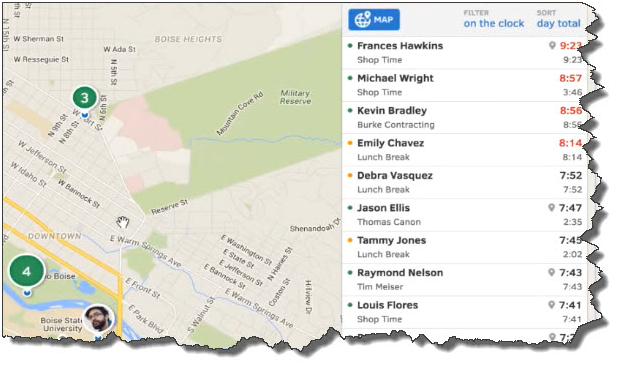
TSheets employee scheduling software automates tasks that QuickBooks Online doesn’t do: scheduling and remote time-tracking for your hourly employees. Your staff no longer has to fill in paper timesheets. Instead, they can use their smartphones to track their hours and GPS location points. And while Excel is certainly better for creating schedules than paper, TSheets takes over that task, too. After you’ve approved timesheets, that information is sent over to QuickBooks, ready for use in your payroll processing.

quickbooks

Your employees can easily “punch” in and out using their smartphones. TSheets also uses GPS technology so that your staff members’ locations are always known to you.

SOS Inventory

QuickBooks Online performs some basic inventory management tasks. You can create records for items and use them in transactions, and keep track of the number of items in stock so you know when to reorder (or have a sale). SOS Inventory goes well beyond those capabilities. You can create sales orders, track cost history and serial numbers, and document work-in-progress (WIP). SOS Inventory supports multiple locations and the entire pick/pack/ship process.

Insightly CRM

You can create thorough customer records in QuickBooks Online and document some of your interaction. But it doesn’t facilitate true Customer Relationship Management (CRM) nor project management. Insightly CRM does both. It lets you build exceptionally thorough customer profiles so that you can view social streams, email history, and any events, opportunities, or events related to them. Its project management features include the ability to track by pipelines or milestones, define contact roles and custom fields, and generate advanced project reporting.

QuickBooks Online Integration Key

All of these apps can work in standalone settings, but their integration with QuickBooks Online and their mobile capabilities create powerful partnerships that help you serve both your customers and your employees in ways that QuickBooks Online alone can’t.

We’re not trying to sell you applications here. Our concern is that you’re getting as much out of QuickBooks itself as you can. We can steer you toward add-on solutions if that seems necessary, but we’re always happy to work with you on getting to know QuickBooks Online better and matching its capabilities to your company’s needs.

Matthew J. Rice CPA also offers training and ongoing assistance for you and your staff. We address your specific needs, ensure the proper set-up of QuickBook’s functions, and help you make the most of your software investment. Take advantage of QuickBooks today! Request a free initial consultation or call us today at 704-609-1119 and ask for Matt Rice.

Filed Under: Quickbooks

New Law Brings Tax Changes for Small Business Owners

November 14, 2018 by byfadmin


The most recent tax reform law effectively reduces taxes for many small businesses. It also creates some new complications. Here are the highlights.

Corporate tax rates are cut.

The graduated corporate tax structure has been replaced by a flat rate of 21%. This represents a significant rollback for corporations in the former top 35% bracket. Of particular note to owners of closely-held C corporations: the new law repeals the corporate alternative minimum tax and makes the simpler cash method of accounting available to more corporations.

Owners of “pass-through” entities gain a new deduction.

The legislation creates a new deduction for 20% of business pass-through income. This deduction is available to owners of almost any type of trade or business whose taxable income does not exceed $315,000 (joint return) or $157,500 (other returns). Above those amounts, the deduction is generally limited to the greater of:

  • 50% of W-2 wages paid by the trade or business, or
  • The sum of 25% of W-2 wages paid plus 2.5% of the original cost of tangible, depreciable assets used in the business.

When the business has more than one owner, the owners use their allocated shares of wages and assets in computing the limitations.

Different restrictions apply to individuals in certain service businesses (e.g., law, medicine, and accounting). For those individuals, the ability to take the deduction is reduced with taxable income between $157,500 and $207,500 ($315,000 and $415,000 on a joint return) and is unavailable once taxable income reaches the top of the applicable range.

The taxable income thresholds will be adjusted for inflation after 2018, and the 20% deduction is scheduled to expire after the 2025 tax year.

Depreciation and expensing provisions are more generous.

  • Bonus depreciation percentage increases from 50% to 100%. Businesses may deduct the full cost of qualifying property acquired and placed in service after September 27, 2017, and before January 1, 2023 (before January 1, 2024 for certain property). Unlike under prior law, the property does not have to be new — used property can also qualify. Starting in 2023 (2024 for certain property), the deduction is gradually scaled back, and it sunsets after 2026.
  • Section 179 expensing limit increases from $500,000 to $1 million. The law doubles the annual expensing limit and raises the investment threshold over which the deduction begins to phase out to $2.5 million. These new limits will be adjusted for inflation after 2018. The new law also makes the Section 179 expensing election available for more types of property, including certain improvements to nonresidential real property.
  • Auto depreciation limits increase more than threefold. The new annual caps are generally effective for business autos placed in service after 2017.

Other changes could have an impact.

  • The deduction for business entertainment expenses is repealed, effective for expenses paid or incurred after 2017.
  • The costs of certain employer-provided transportation fringe benefits, such as transit passes, are no longer deductible, also effective for expenses paid or incurred after 2017.
  • For the 2018 and 2019 tax years, employers that provide paid family and medical leave may claim a credit for a portion of the expense (requirements apply).
  • The domestic production activities deduction is repealed, effective for 2018 and later tax years.

These are just highlights of some of the changes included in the Tax Cuts and Jobs Act of 2017. Please consult Matthew J. Rice, CPA, for more detailed information about how the law’s provisions may apply to your business and personal tax situation.

We offer a variety of tax planning services to both businesses and individuals. Conscientious tax planning throughout the year can save you money and make tax time easier. Call us at 704-609-1119 and request a free initial consultation to learn more.
Source/Disclaimer:

This communication is not intended to be tax advice and should not be treated as such. You should contact your tax professional to discuss your specific situation.

Filed Under: Doing business

Year-End Tax Planning – Get an Early Start

October 24, 2018 by byfadmin

charlotte cpa accounting and tax firmAlthough tax season might seem as if it’s a long way off, tax planning in the months before year-end allows you to take advantage of strategies that might help reduce your income tax obligation. Reviewing commonly used strategies will help you identify those that might be useful to you.

Capitalize on Winners

Your investments are a good starting point for implementing tax-saving strategies. You can benefit from favorable tax rates on long-term capital gains by selling and taking profits on appreciated securities you’ve held longer than one year. Long-term gains are currently taxed at a maximum rate of 15% for most taxpayers and 20% for taxpayers with taxable income of over $425,800 ($479,000 for joint filers) in 2018.

Cut Your Tax Bite With Losers

Investments that have lost value and have consistently underperformed a benchmark over time may be perfect sell candidates, particularly if you’re not confident of a turnaround. By selling your losers, you can use your losses to balance out gains on appreciated securities you’ve sold. Capital losses are fully deductible to offset capital gains and up to $3,000 of ordinary income each year ($1,500 if married filing separately). Any losses that you can’t deduct for 2018 can be carried over for deduction in future years, subject to the same limits.

Don’t make taxes your only reason for selling an investment. Many different factors should go into the decision to sell securities, including how the sale of a specific investment would affect your overall portfolio.

Curb Surtax Exposure

The 3.8% surtax on net investment income is a relatively new wrinkle for higher income taxpayers. The surtax comes into play when an individual filer’s modified adjusted gross income (AGI) is more than $200,000 ($250,000 on a joint return or $125,000 if married filing separately). The surtax applies to the lesser of net investment income or the amount by which modified AGI exceeds the threshold. For purposes of the surtax, net investment income includes taxable interest, dividends, annuities, royalties, rents, net capital gain, and income from passive trade or business activities. The surtax doesn’t apply to municipal bond interest or distributions from tax-deferred retirement plans.

A number of planning moves are available that may help reduce your exposure to the surtax. These include:

  • Maximizing contributions to your employer’s qualified retirement plan. For 2018, you can contribute up to $18,500, plus an additional catch-up amount of $6,000 if you’re age 50 or older and your plan allows. Pretax contributions to a tax-qualified plan reduce your taxable income.
  • Contributing to a traditional individual retirement account (IRA). Contributions are tax deductible if neither you nor your spouse actively participates in an employer-sponsored retirement plan. For 2018, the contribution limit is $5,500 ($6,500 with catch-up contribution).
  • Investing in tax-free municipal bonds. Be cautious, however, about investing in private activity municipal bonds, which can increase your exposure to the alternative minimum tax (AMT).
  • Deferring capital gains through the use of installment sales. The installment method lets you defer taxes on the sale of certain property by recognizing profit over more than one tax year.

Some strategies may not be appropriate for your situation. Check with your tax advisor.

From income tax preparation for individuals to complex corporate taxes for businesses, you’ll like working with us because we make filing taxes easy. Just send us your paperwork, receipts, and prior tax returns and Matthew J. Rice, CPA will take care of everything. Call 704-609-1119 or request a free consultation online.

Filed Under: Individual Tax

  • « Previous Page
  • Page 1
  • …
  • Page 6
  • Page 7
  • Page 8

Primary Sidebar

Follow Us!

Follow Us on FacebookFollow Us on TwitterFollow Us on LinkedInFollow Us on E-mail

Search

Category

  • Best Business Practices
  • Business Tax
  • Doing business
  • Estate and Trusts
  • Individual Tax
  • Investment
  • IRS
  • Quickbooks
  • Real Estate
  • Retirement
  • Tax Law Changed
  • Uncategorized

Archive

  • September 2025
  • August 2025
  • December 2024
  • November 2024
  • October 2024
  • September 2024
  • August 2024
  • July 2024
  • June 2024
  • May 2024
  • April 2024
  • March 2024
  • February 2024
  • January 2024
  • December 2023
  • November 2023
  • October 2023
  • September 2023
  • August 2023
  • July 2023
  • June 2023
  • May 2023
  • April 2023
  • March 2023
  • February 2023
  • January 2023
  • December 2022
  • November 2022
  • October 2022
  • September 2022
  • March 2020
  • February 2020
  • January 2020
  • December 2019
  • November 2019
  • October 2019
  • September 2019
  • August 2019
  • July 2019
  • June 2019
  • May 2019
  • April 2019
  • March 2019
  • February 2019
  • January 2019
  • December 2018
  • November 2018
  • October 2018
  • January 2018
  • December 2017
  • January 2017
  • December 2016
  • December 2015
  • October 2015
  • September 2015
  • July 2015
  • December 2014
  • September 2014
  • January 2014
  • December 2013
  • November 2013
  • September 2013
  • August 2013
  • June 2013
  • January 2013
  • December 2012
  • November 2012
  • September 2012
  • August 2012
  • July 2012
  • June 2012
  • May 2012
  • April 2012
  • February 2012
  • January 2012

Recent Posts

  • What is the Qualified Business Income Deduction?
  • Tax Planning for the Solopreneur
  • Projects That Add to the Value of Your Home
  • Transform Your Business Operations by Harnessing the Power of AI
  • An HSA Can Also Be Used to Save for Retirement

Recent Comments

    Copyright © 2018 · http://cpa-charlotte.com/blog